
Overview
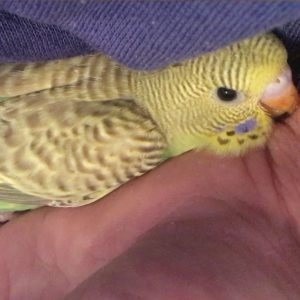
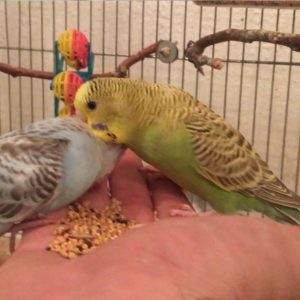
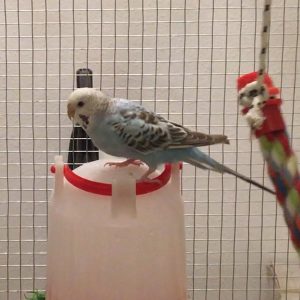
The Cinnamon mutation is a sex-linked recessive mutation in budgies that changes the normally black or dark-grey markings into a warm brown shade.
It affects the markings on the head, neck, wings and throat spots while also softening the bird’s overall body colour. The result is a budgie with a warmer, lighter and more delicate appearance than a normally marked bird.
As its name suggests, the easiest way to recognize this mutation is to look for cinnamon-brown markings
Genetic Basis
- Chromosomes: In the simplified notation used throughout our mutation guides, male budgies are XX and females are XY.
- Inheritance: The Cinnamon gene is carried on the X chromosome and is recessive to the normal gene.
- Males (XX): A male must inherit two copies of the Cinnamon gene to visually express the mutation. A male with only one copy looks normal but is called split Cinnamon.
- Females (XY): A female needs only one copy of the Cinnamon gene to visually express the mutation because she has only one X chromosome.
- Female carriers: A female cannot be visually normal while secretly carrying Cinnamon. She is either Cinnamon or she is not Cinnamon.
This inheritance pattern is the same as that of other sex-linked recessive mutations, including Opaline and Ino.
Visual Characteristics
Brown markings
The clearest feature of a Cinnamon budgie is the colour of its markings.
The markings that would normally be black or dark grey become a warm cinnamon-brown colour. This includes:
- Wing markings
- Head and neck barring
- Throat spots
- Markings around the crown
The shade may range from a soft coffee-brown to a deeper warm brown. Cinnamon markings can also appear darker in some males than in females.
When comparing a Cinnamon budgie with a normally marked budgie, the difference is especially noticeable on the wings. The normal bird has strong black markings, while the Cinnamon has much softer brown markings.
Diluted body colour
Cinnamon also reduces the depth of the bird’s body colour.
The green or blue body colour is usually around half the intensity of the corresponding normally marked budgie. However, the colour should remain even across the body rather than appearing irregular or patchy.
A Cinnamon green-series budgie therefore appears as a softer and warmer shade of green, while a Cinnamon blue-series budgie appears as a lighter, more pastel blue. The softer markings and reduced body colour often give the feathers a smooth or silky appearance.
Cheek patches
The cheek patches remain violet, but they are usually softer and paler than those of a normal budgie.
Their exact appearance can vary depending on the bird’s base colour and any additional mutations it carries.
Feet and legs
Cinnamon budgies usually have pink or pinkish feet and legs rather than the blue-grey feet commonly seen in normally marked budgies.
This is another helpful clue, although foot colour should not be used alone to identify the mutation because other mutations can also produce pink feet.
Eyes
Adult Cinnamon budgies have dark eyes and normally develop a visible white iris ring as they mature.
Cinnamon chicks can initially have plum-coloured or reddish-brown eyes. The eyes darken after the first few days, making this feature much less obvious in older birds. Cinnamon chicks also tend to have pinker skin and white down rather than the grey down of normal chicks.
This is important when distinguishing Cinnamon from mutations such as Fallow. Fallows retain noticeably red eyes, while an adult Cinnamon normally has dark eyes with a white iris ring.
Tail feathers
The long tail feathers are usually lighter and softer in colour than those of the corresponding normally marked budgie.
Their exact shade depends on whether the bird belongs to the green or blue series, its dark factor and any other mutations present.
Cere colour
The Cinnamon mutation does not normally create a special adult cere colour.
Mature males generally develop the usual blue male cere. Females may have a pale blue or whitish cere when they are not in breeding condition, becoming tan or brown when in breeding condition.
The cere should therefore be assessed according to the bird’s sex, age and hormonal condition rather than used as the main sign of Cinnamon.
Cinnamon Combined with Other Mutations
Cinnamon can occur together with many other mutations, changing the bird’s final appearance.
Cinnamon Opaline
A Cinnamon Opaline has both the warm brown markings of Cinnamon and the altered wing and head pattern of Opaline.
In a blue-series Cinnamon Opaline, blue body colour may appear between or around the brown wing markings where a normal bird would usually show white areas. In the green series, green body colour may replace much of the normal yellow edging.
The Opaline mutation may also create:
- A larger area of body colour on the back of the head
- Reduced or broken barring
- More body colour within the wings
- A brighter or more colourful overall appearance
Because the markings are brown rather than black, a Cinnamon Opaline often has an especially soft, pastel appearance.
Cinnamon Ino — Lacewing
When Cinnamon and Ino are inherited together in the correct genetic combination, they can produce the mutation known as Lacewing.
A Lacewing resembles an Ino budgie but retains pale cinnamon markings rather than losing the markings almost completely. Cinnamon is therefore one of the mutations involved in producing the Lacewing variety.
How to Identify a Cinnamon Budgie
When trying to identify Cinnamon, look at the bird as a whole rather than relying on a single feature.
The strongest combination of clues is:
- Brown wing, head and throat markings instead of black
- Softer and lighter body colour
- Pink or pinkish feet
- Dark adult eyes with a normal white iris ring
- A smooth, warm and pastel overall appearance
Do not identify every budgie with brown-looking markings as Cinnamon. Lighting, image quality, juvenile markings and other mutations can make black markings appear brown in photographs.
It is best to compare the suspected bird directly with a normally marked budgie under natural lighting.
Distinguishing Cinnamon from Similar Mutations
Cinnamon vs Greywing
Both Cinnamon and Greywing can soften the bird’s appearance and dilute its body colour.
However:
- Cinnamon: Markings are warm brown.
- Greywing: Markings are grey.
The actual colour of the wing markings is usually the most important difference.
Cinnamon vs Fallow
Fallow budgies can also have brown markings, pink feet and diluted body colour, making them easy to confuse with Cinnamon.
The eyes provide the clearest distinction:
- Cinnamon: Adult eyes become dark and usually develop a white iris ring.
- Fallow: Eyes remain visibly red or ruby-coloured.
Fallows also tend to have considerably weaker body colour than Cinnamons.
Cinnamon vs Dilute
A Dilute budgie has extremely pale body colour and very faint grey markings.
A Cinnamon usually retains more body colour, and its markings are distinctly warm brown rather than pale grey.
Significance
Cinnamon is one of the classic budgie colour mutations.
Its warm brown markings, softer body colour and smooth pastel appearance make it attractive both as an individual mutation and in combinations such as Cinnamon Opaline and Lacewing.
It is also an important mutation for learning budgie genetics because its sex-linked inheritance follows the same basic rules as Ino and Opaline.
Breeding Notes
Symbols
- X = Normal allele
- Xᶜ = Cinnamon allele
- Y = Female chromosome
Because Cinnamon is sex-linked recessive:
- A male needs two Cinnamon alleles to appear Cinnamon.
- A male with one Cinnamon allele is split Cinnamon.
- A female needs only one Cinnamon allele to appear Cinnamon.
- Females cannot be split Cinnamon.
The percentages below describe the statistical probability for each chick. They do not guarantee that every clutch of four chicks will contain exactly one chick of each type.
Punnett Square Examples
Example 1: Cinnamon Male × Normal Female
Cinnamon male: XᶜXᶜ
Normal female: XY
| X from female | Y from female | |
|---|---|---|
| Xᶜ from male | XᶜX — Split Cinnamon male | XᶜY — Cinnamon female |
| Xᶜ from male | XᶜX — Split Cinnamon male | XᶜY — Cinnamon female |
Result:
- 50% split Cinnamon males
- 50% Cinnamon females
- No visually Cinnamon males
- No normal females
All sons will look normal but carry Cinnamon, while all daughters will visually express Cinnamon.
Example 2: Split Cinnamon Male × Normal Female
Split Cinnamon male: XᶜX
Normal female: XY
| X from female | Y from female | |
|---|---|---|
| X from male | XX — Normal male | XY — Normal female |
| Xᶜ from male | XᶜX — Split Cinnamon male | XᶜY — Cinnamon female |
Result:
- 25% normal males
- 25% split Cinnamon males
- 25% normal females
- 25% Cinnamon females
In this pairing, any visually Cinnamon offspring will be female.
A normal-looking male chick from this pairing cannot be identified as split or non-split by appearance alone. Breeding records or a genetic test would be needed to confirm whether he carries Cinnamon.
Example 3: Split Cinnamon Male × Cinnamon Female
Split Cinnamon male: XᶜX
Cinnamon female: XᶜY
| Xᶜ from female | Y from female | |
|---|---|---|
| X from male | XᶜX — Split Cinnamon male | XY — Normal female |
| Xᶜ from male | XᶜXᶜ — Cinnamon male | XᶜY — Cinnamon female |
Result:
- 25% split Cinnamon males
- 25% Cinnamon males
- 25% normal females
- 25% Cinnamon females
Overall, this pairing gives a 50% chance of producing a visually Cinnamon chick.
Example 4: Cinnamon Male × Cinnamon Female
Cinnamon male: XᶜXᶜ
Cinnamon female: XᶜY
| Xᶜ from female | Y from female | |
|---|---|---|
| Xᶜ from male | XᶜXᶜ — Cinnamon male | XᶜY — Cinnamon female |
| Xᶜ from male | XᶜXᶜ — Cinnamon male | XᶜY — Cinnamon female |
Result:
- 50% Cinnamon males
- 50% Cinnamon females
- 100% of the offspring will be Cinnamon
Conclusion
The Cinnamon mutation replaces the normally black markings of a budgie with a warm brown shade while also softening the body colour, cheek patches and overall appearance.
Its most important identification feature is not simply that the bird looks pale, but that the wing markings, head barring and throat spots are genuinely brown instead of black or grey.
Because Cinnamon is a sex-linked recessive mutation, males can carry it without showing it, while females are either visually Cinnamon or do not carry the gene at all. Once this inheritance pattern is understood, the same Punnett-square principles used for Ino and Opaline can also be applied to Cinnamon.